
Finding Hamilton County Residents
Hamilton County records work best when the starting point is clear. A street or parcel belongs with the Auditor. A deed, mortgage, or legal transaction belongs with the Recorder. An estate or marriage question belongs with Probate Court. A court case begins with the Clerk. The public record may identify an owner, party to an instrument, litigant, or historical directory listing, but those are separate roles. A strong result keeps the role and date attached rather than turning one matching name into a claim about an entire household.
Use two independent records when identity matters. The county property view can supply a parcel and transfer date. A recorded instrument may confirm the legal-description trail. A historical directory may place a named householder at an earlier address. The order changes with the question, but checking a second, date-compatible source avoids the common same-name error.
- Begin with the Hamilton County Auditor Property Search when a name, street, or parcel is known. Save the displayed parcel, site address, and transfer details.
- Use the property transfer view, then take a party name, Auditor number, or book and page reference to the Recorder's Acclaim inquiry.
- For a case or estate question, search the Clerk or Probate index by the correct record category rather than assuming a property result answers it.
- For an older household, check the digitized directory collection and compare its year with census, map, and deed evidence.
- When the online route is incomplete, ask the identified custodian for its counter, copy, archive, or Ohio Public Records Act procedure.
Hamilton County Parcel Roles
The Auditor property summary is a current property record, not a household list. Its fields distinguish the site address from the owner name and address, the tax-bill mail address, tax district, legal description, values, sales information, and transfer data. The mailing address can be elsewhere. That label is useful for sending a tax bill, but it should not be converted into a statement that a person occupies the parcel.
Searches can begin with an owner name, street address, parcel ID, sales, or the advanced form. A result gives the bridge the Recorder needs: a parcel identifier, legal-description language, and a current or prior party name. This is why a location search belongs on the property system before it reaches the Recorder, whose document index is not an address directory.
The Auditor's public search shows the property pathways used to connect an address with its parcel record.
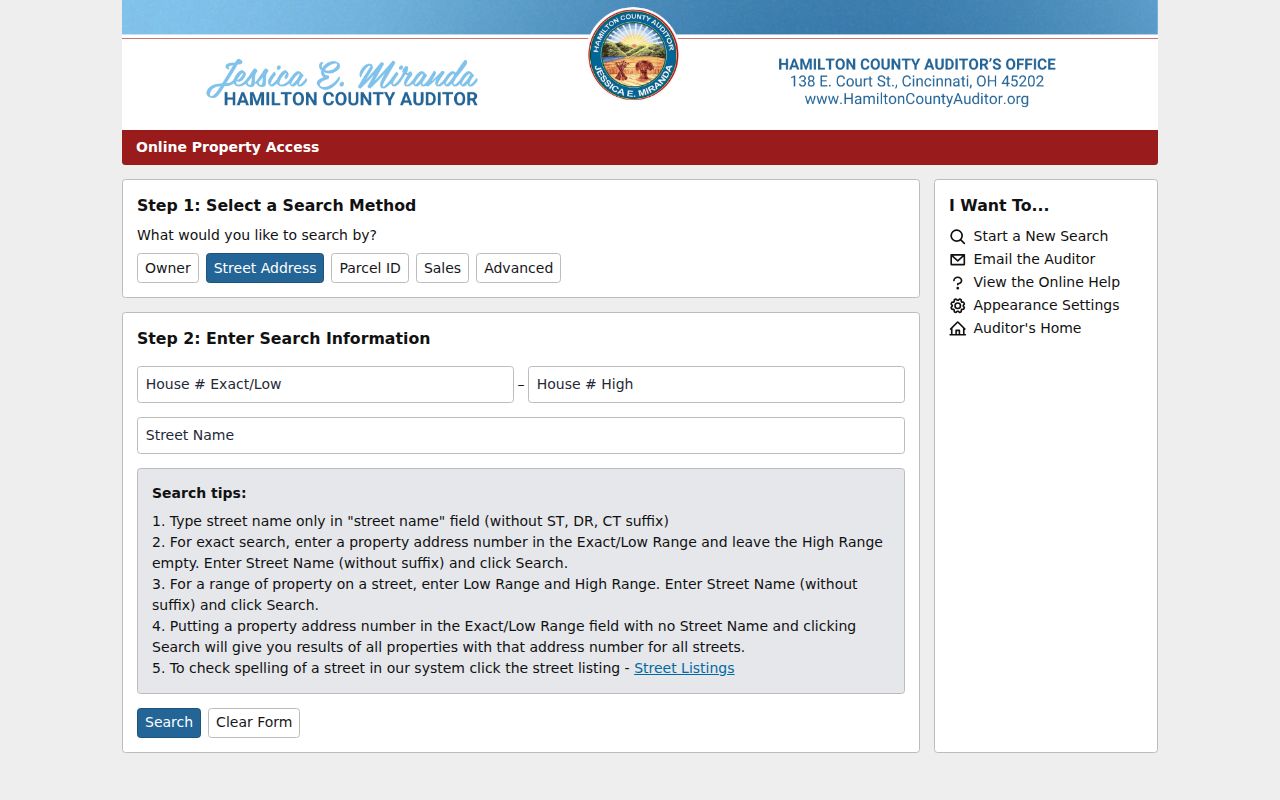
The result should be read by its labels, especially where a mailing field and a physical-property field differ.
- Parcel
- A county property identifier that links a physical tract to tax and transfer records.
- Situs address
- The physical address attached to the property record.
- Tax-mail address
- The correspondence address shown for tax purposes, which can differ from the situs address.
- Legal description
- The tract, lot, subdivision, or metes-and-bounds description used in recorded title documents.
Hamilton County Resident Record Offices
The Recorder, Auditor, and elections offices each maintain a different public-facing record. The Recorder preserves the documentary trail of instruments. The Auditor provides the parcel and ownership-facing entry point. The Board of Elections and state voter tools handle voter records within statutory limits. For cases, the Clerk of Courts and Probate Court are separate custodians with their own online and counter access. Their systems overlap in names, not in purpose.
Hamilton County Recorder
138 E. Court St., Room 205
Cincinnati, OH 45202
513-946-4571
Hamilton County Board of Elections
Ohio voter records and county election resources
Use official status and list channels
Public voter records are governed by Ohio law
Note: A custodian can explain how to request or inspect a record, but it cannot decide what a search result means for a personal matter.
Hamilton County Names in Acclaim
Acclaim is the Recorder's free public document inquiry. It offers routes for a name, record date, date range and document type, book and page, document number, subdivision and lot, section-town-range, Auditor number, subdivision name, and certificate number. A property researcher can carry the Auditor number or legal description into the document search. For most material from 1988 forward, the county guide treats name searching as the usual route. Older deed work follows the historic grantor and grantee books before returning through Book/Page.
Acclaim's name-search screen supports name, date, and document filters rather than a simple street-address field.
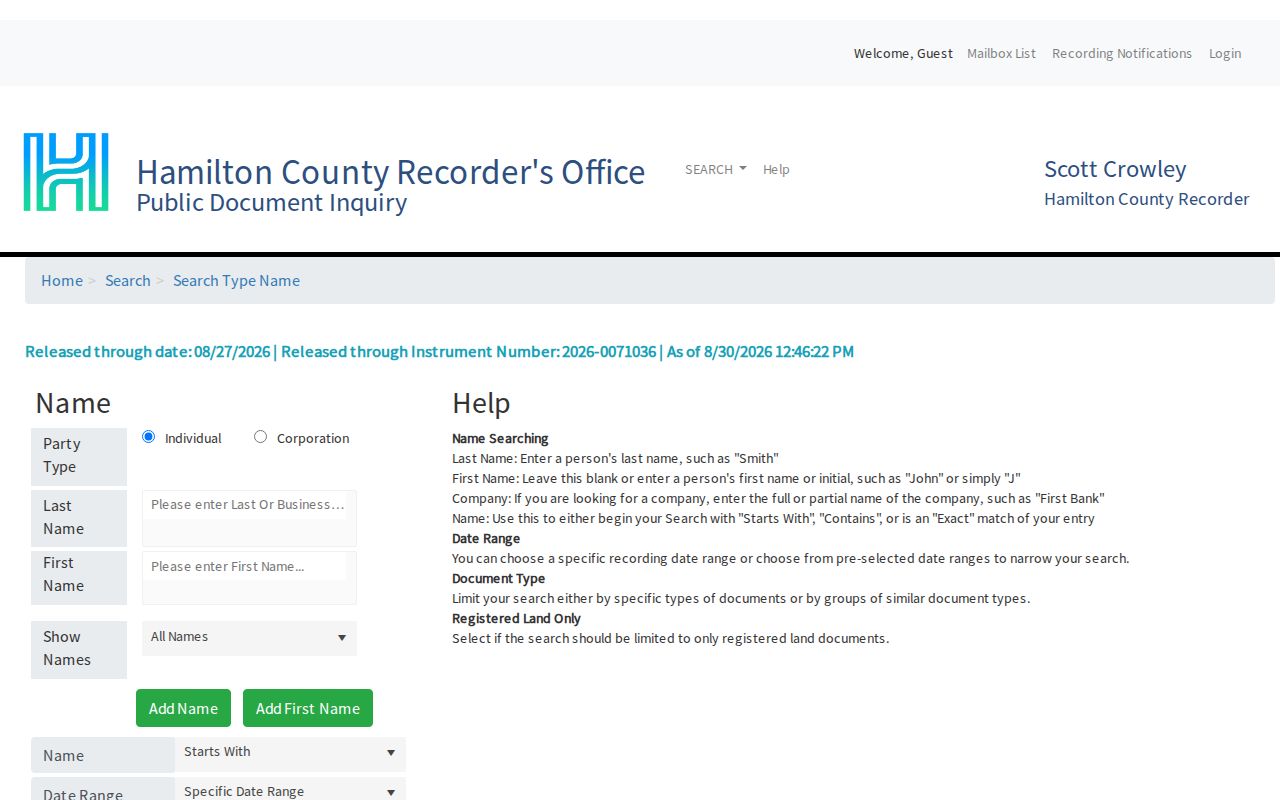
Matching party role, recording date, and legal description gives the result more weight than a surname alone.
| Acclaim field | How it narrows a record |
|---|---|
| Party type and name | Separates individual and corporation searches, with an optional second party criterion. |
| Date range | Limits results to a recording period or portal preset range. |
| Document type | Applies a selected document category when the index provides it. |
| Auditor number | Connects a property parcel reference to recorded-document results. |
| Book and page | Retrieves a historic reference after the grantor/grantee index supplies it. |
Hamilton County Court and Probate Checks
A court party index is a separate identity check, not a substitute for property research. The Clerk of Courts Records Search covers Common Pleas civil and criminal, Municipal civil and criminal or traffic, liens, appellate, and domestic-relations material. Remote access can be narrower than counter access, and sealed or restricted classes are not a negative finding. A specific case number, party role, date window, or court category makes the request more useful.
Probate Court supplies a different trail. Its public inquiry describes a probate case index from 1974, docket information from 1993, and documents from 2000. The marriage index is a separate alphabetical bride and groom tool from 1984. Its archive reaches to 1791 across changing record series. That depth makes Probate a valuable route for a well-defined estate or marriage question, while the counter and published request form remain options for records beyond online images.
Hamilton County Probate Court Public Inquiry separates current case searching, marriage records, and archival material.
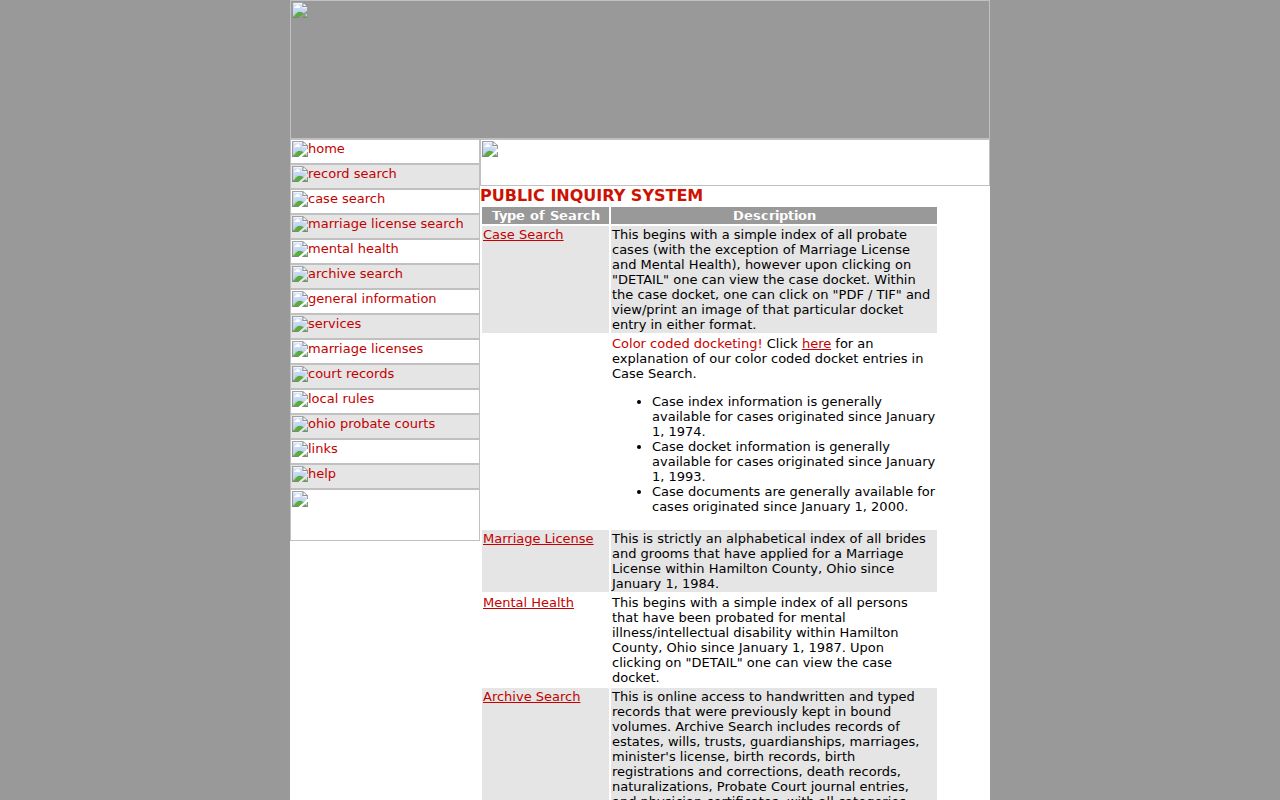
A docket is an event list for a case. It should be read with the case category and date limits shown by the court.
Current Hamilton County Resident Sources
No master roll lists all current Hamilton County residents. Each source describes a limited relationship to an address or name. The table keeps those relationships visible, which is especially important when several people share a surname or when a parcel has a tax-bill address outside the county.
| Source | Role it records | Custodian | Access route |
|---|---|---|---|
| Property Search | Owner, site and tax-mail labels, parcel, transfer data | Hamilton County Auditor | Free public portal; counter fallback |
| Acclaim documents | Parties to recorded instruments and legal-description trail | Hamilton County Recorder | Free index and images; books and copies through office |
| Voter tools | Individual voter status and lawful public list products | Ohio and Hamilton County elections offices | State lookup and county channels, subject to protected-voter rules |
| Court and Probate indexes | Party, case, estate, or marriage-index roles | Clerk of Courts and Probate Court | Online index plus specified counter or copy request |
| City directories | Historical printed listing or householder entry | CHPL and partner repositories | Digitized collection, library help, archives, and in-person resources |
When the question is about a particular person rather than a record role, the Hamilton County resident lookup uses this same evidence in a stricter two-source check.
Hamilton County Voter Record Boundaries
Ohio voter-registration lists are public records under R.C. 3503.15, with protected-voter rules in R.C. 3503.13. The state voter lookup is an individual status, precinct, and polling-place route. The Board of Elections also publishes public voter-list tools by legally defined categories such as district, precinct, and party. Neither route is a full household list, and a missing name can reflect a protected record, a nonvoter, a different jurisdiction, or search terms that do not match the record.
Ohio Voter Lookup is the official individual-status path for a voter record.
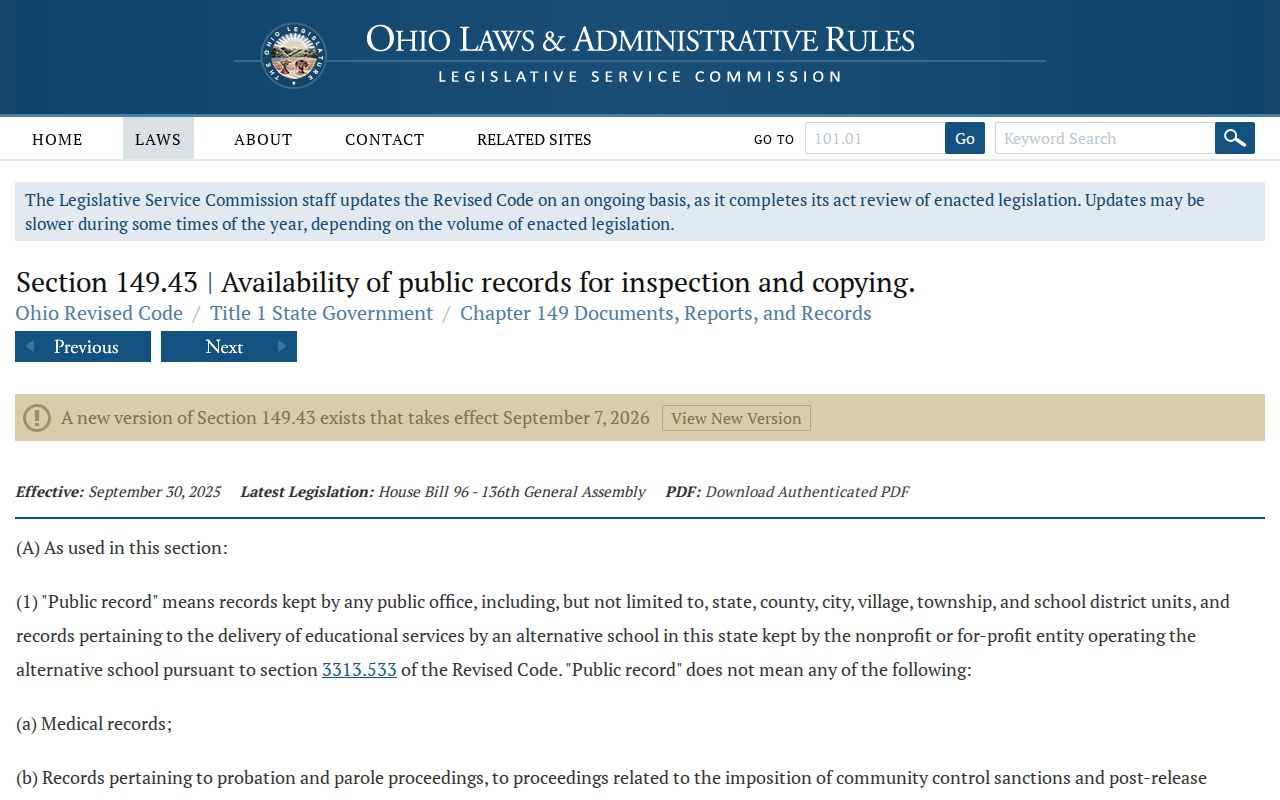
Public-access rules support inspection and copying while still preserving exemptions and protected personal information.
Hamilton County Records Request Fallbacks
Ohio's Public Records Act, R.C. 149.43, is the fallback when a defined public record is not online. A narrow request should name the custodian, record class, address or parcel if known, and a useful time window. The request should ask for inspection or a specified copy format. That gives the office a record it can search, identify for redaction, or explain as unavailable. A broad request for everyone at an address does not correspond to one defined county record set.
Online results are not the only access channel. The Recorder has historic books and office copies. The Auditor has older cards, maps, and records that may need an availability inquiry. Court and Probate offices have their own counter and copy routes. CHPL, Cincinnati History Library and Archives, University of Cincinnati collections, and Ohio History Connection offer library and archival alternatives for historical questions. A no-result on a web form may be a spelling problem, date boundary, scan gap, protected category, or wrong custodian.
Hamilton County Historical Resident Directories
The Cincinnati and Hamilton County Public Library's digitized City and County Directories collection reaches from 1819 to 1953, but its coverage is not uninterrupted. The Hamilton County Genealogical Society documents additional city, county, suburban, Norwood, and specialized runs. A volume can show a period listing with a name, address, and sometimes occupation or spouse notation. It cannot establish a complete household or ownership by itself.
CHPL Genealogy and Local History provides research-level local-history help, while the digitized collection and physical repositories provide different routes into the same past. The dedicated Hamilton County city directories page explains the local runs, Criss-Cross volumes, and entry-reading method in depth.
CHPL's genealogy desk connects directory work with maps, newspapers, and historical indexes.
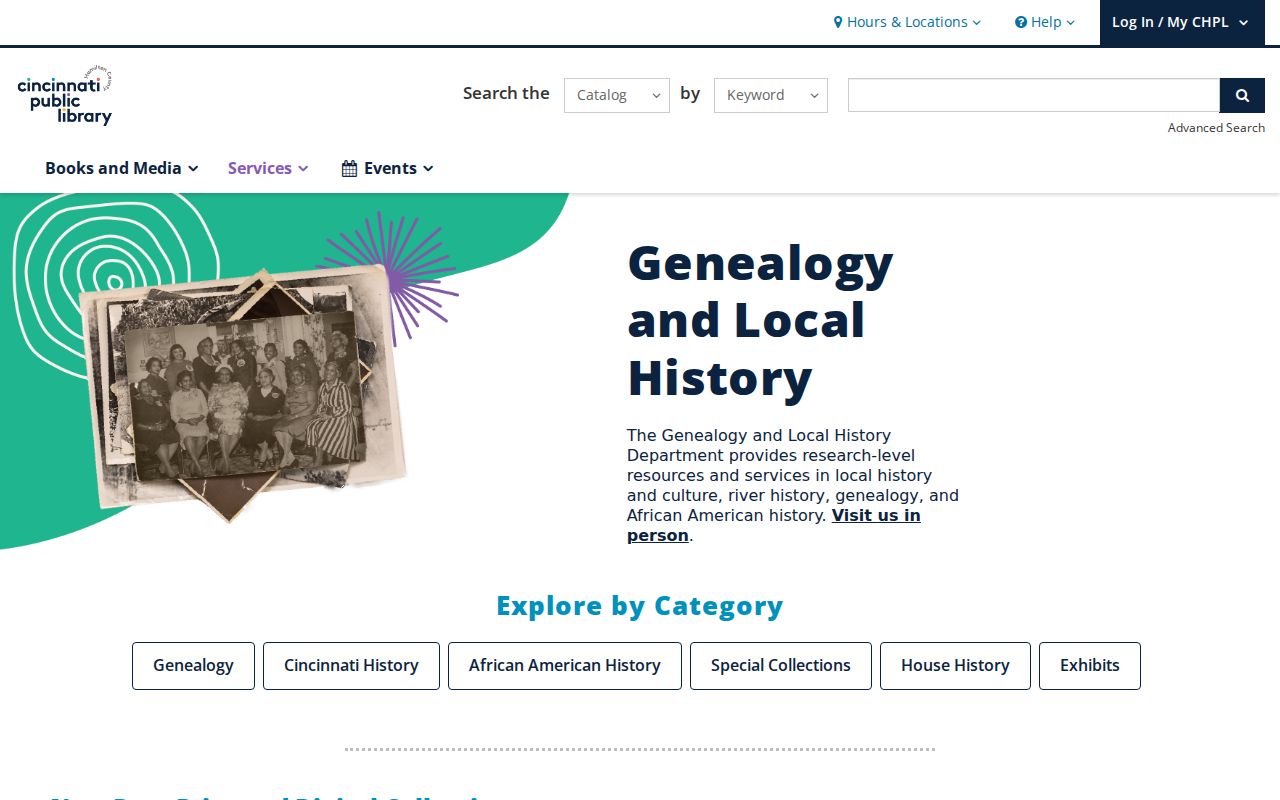
Pairing a printed entry with a census year, map, or recorded instrument keeps the historical context clear.
Hamilton County's 1895 Address Break
Most Cincinnati street numbers changed in 1895. The local house-history guidance points researchers to 1891 Sanborn maps for old numbers and 1904 maps for new ones. The Recorder's historic material also includes a 1913 Cincinnati Street Index. An old address should therefore be translated through period maps or the index before a directory, deed, or census line is joined to a modern-looking address. Treat the conversion as evidence, not as a spelling cleanup.
This local break is why an apparently missing household can still be found under a different number. It also explains why a property record, legal description, and map layer are safer anchors than postal wording alone. The approach is especially useful when a historical street search reaches a good surname but the house number does not line up.
Hamilton County Recorder Alerts and History
The Recorder's index reaches from 1789 to the present online, but the search path changes with the era. Typed grantor/grantee sheets ended May 31, 1988, when the office entered a computer system. Images were scanned into the electronic database from 1988, while early deed-book scanning has continued over time. The right conclusion is not that every early record image is online. It is that the office preserves a long index tradition with separate image, book, and counter routes.
The Recorder also offers a free recording-notification service. It accepts up to five exact name variations for an email address and watches future recordings after enrollment. The alert is a prompt to inspect document detail, not proof of a transaction and not a parcel-monitoring service. Older documentary questions still require Acclaim, historic books, or the office.
The Sheriff's public-records request information is one example of the county office channels available when a specific record class is not displayed online.
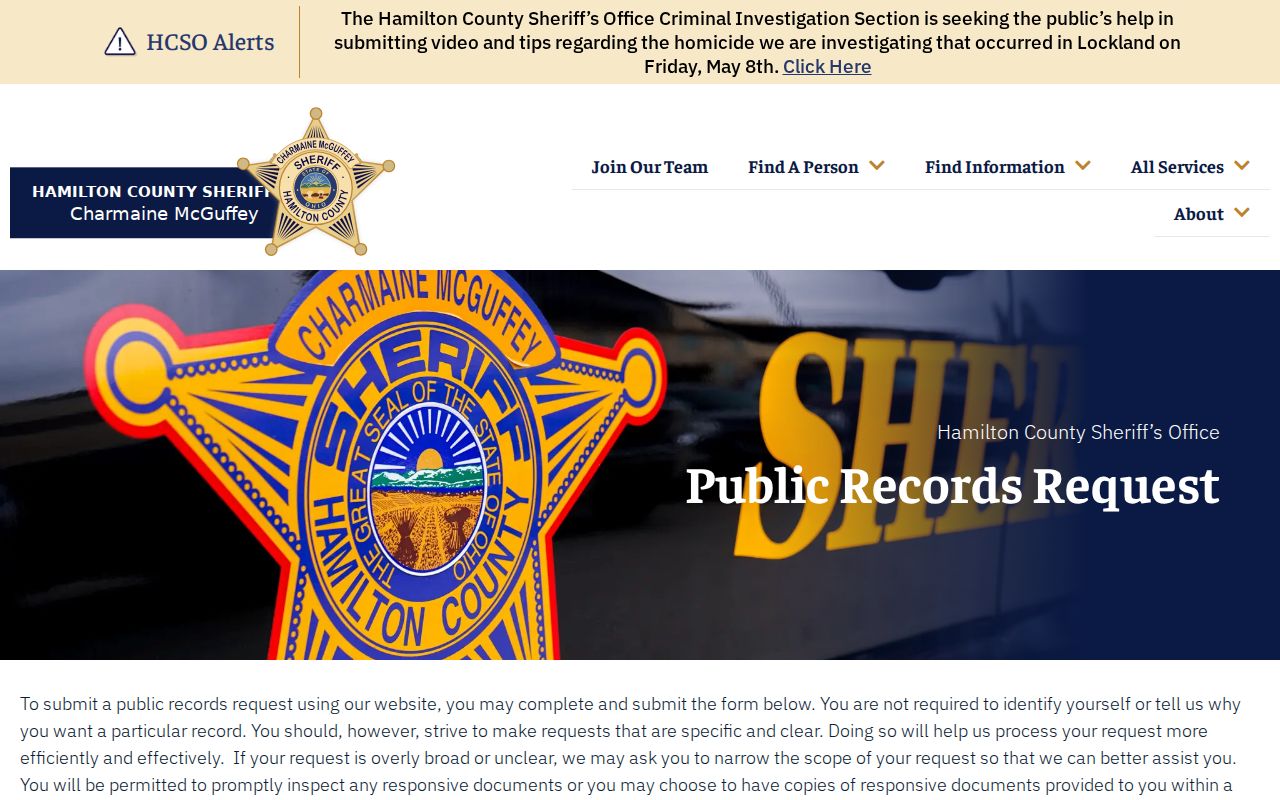
A request works best when it identifies a concrete record rather than asking an agency to create a new directory.
Note: The 1884 courthouse riot and fire destroyed many county records, while Recorder records were saved, so historical gaps require source-by-source checking.